I grew up with a jambiya in the house. It was my dad’s, always there when I was younger, and at some point I was given one of my own, which to a boy was about the coolest thing a person could own. I didn’t wear it every day, but I’d put it on now and then, and owning it was really the point.
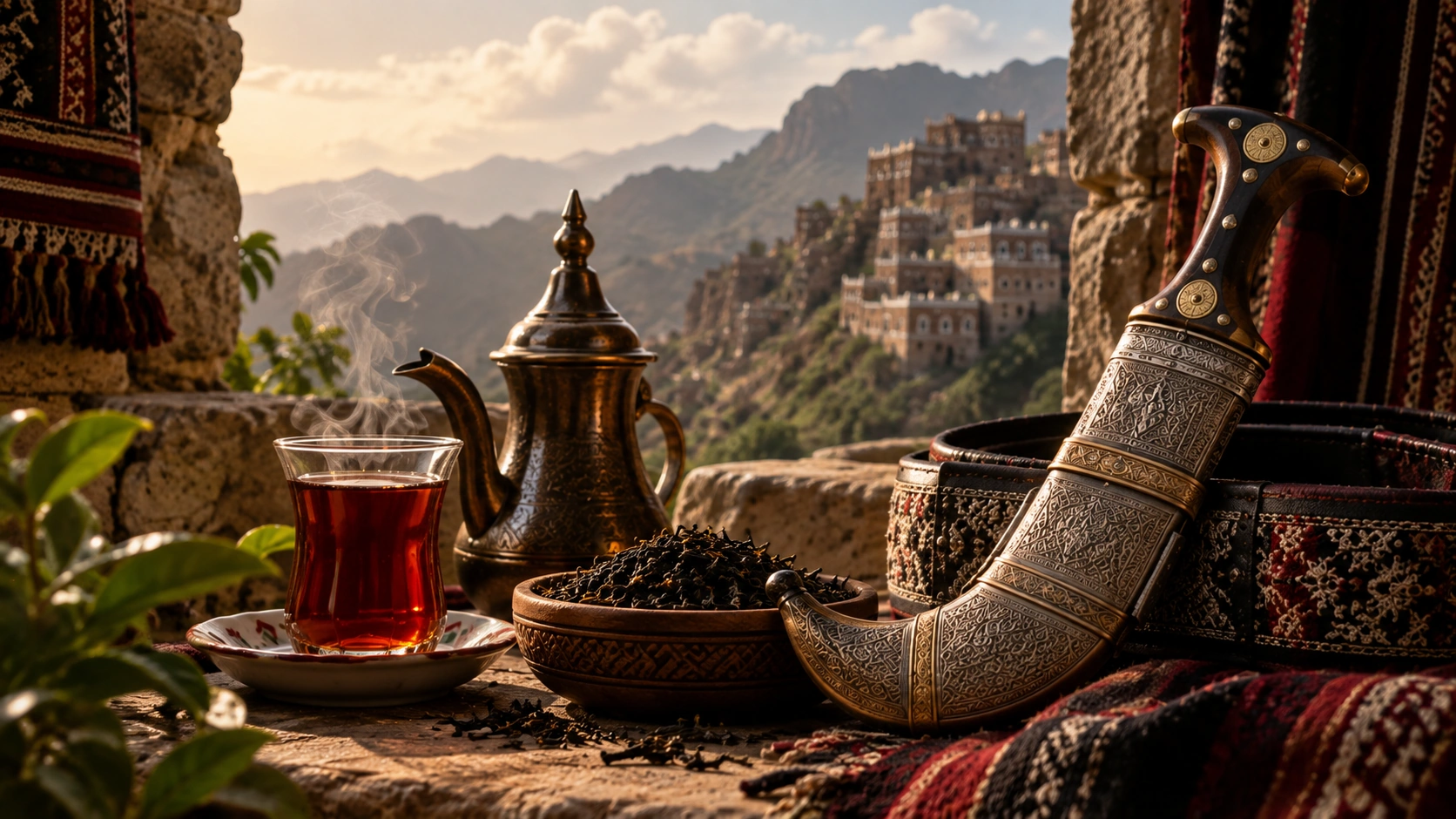
If you didn’t grow up with one, a Yemeni jambiya is a short, curved dagger worn tucked into the front of a wide belt. You’ll still see them in Sana’a, on men at weddings and at Eid, and in the shops of the old city where they’re made and sold. The more I read about it, the better its story got.
What the name jambiya means
The word comes from the Arabic root j-n-b (جنب), which has to do with the side, so a jambiya is roughly “the thing worn at your side.” Yemeni men then went ahead and wore it right in the middle of the stomach, which I find quietly funny.
The blade curves like a crescent and is sharp on both edges, broad where it leaves the handle and narrowing to a point, with a raised ridge running all the way down its length. A Sabaean statue from around 500 BCE shows an early version, though today’s curved shape probably settled between the 15th and 17th centuries. Once firearms arrived in the 16th century, the jambiya slowly went from something you fought with to something you were known by, a mark of honour and of your standing among your people.
The Yemeni jambiya is all about the handle
If you want to know what a jambiya dagger is worth, you look at the handle long before you look at the blade. Everyday ones are cow horn or wood (or plastic, for the cheapest), while the grander ones are dressed in silver or amber.
At the very top sits the saifani, a handle of rhinoceros horn with a warm, brownish-yellow colour. Unlike most things, it gets better with age, its lustre deepening the longer it’s handled, which helps explain why antique jambiyas with rhino-horn handles have been valued at as much as a million pounds.
That appetite came at a real cost to the rhinos. Between 1972 and 1978, merchants in North Yemen, as it then was, imported around 40% of all the rhino horn on the world market. Imports were banned in 1982, and after years of enforcement and public awareness campaigns the demand all but disappeared.
What a Yemeni dagger says about the man wearing it
The sheath has something to say too. Most men wear the 'asib (العسيب), which stands upright at the front of the belt with its tip curling sharply up to the right, a bit like a hook. Judges and sayyids, families descended from the Prophet, traditionally wore a different style called the _thuma (جنبية ثومة), set at an angle across the body, so a glance at a man’s belt could tell you a surprising amount about his family. The belts are a craft of their own, wide and often stitched with gold thread, and in the old quarter of Sana’a many are still sewn by hand.
A boy’s first jambiya marks his step towards manhood, traditionally somewhere in his mid-teens, though some are given one younger. Writing for the Penn Museum in 1977, one researcher described small boys in a town on Yemen’s Tihama coast drawing jambiyas on the walls, waiting for the day they’d be allowed to wear the real thing. Having had one of my own as a boy, I understand them completely.
Handed over to keep the peace
My favourite part of the story is what happens when things go wrong. In tribal disputes, the men involved have long handed their jambiyas over to a mediator or sheikh, who keeps them until the matter is settled. It’s a pledge, and a serious one, because what a man is giving up is the object that stands for his honour.
When things go right, the jambiyas come out for a happier reason. At weddings and celebrations men dance the bara’a (برعة), a big circle gathered around two or three dancers who move to the drums with their jambiyas raised. It started life as a war dance, and it’s still the best-loved folk dance in Yemen.
Where the jambiya meets a glass of tea
We sell tea rather than daggers, so I’ll keep this bit short. The occasions when the best jambiyas come out, the weddings and the Eid visits, are the same ones where guests are usually handed a small glass of spiced tea before anything else happens. That’s the part of the picture we’re trying to bring to your kitchen with Warda, and if you’re curious how it’s made, our post on the Yemeni tea tradition goes through it.
And the next time you see a photo of a man in Sana’a with a curved dagger at his belt, have a look at the handle, because it may well have been his father’s first.